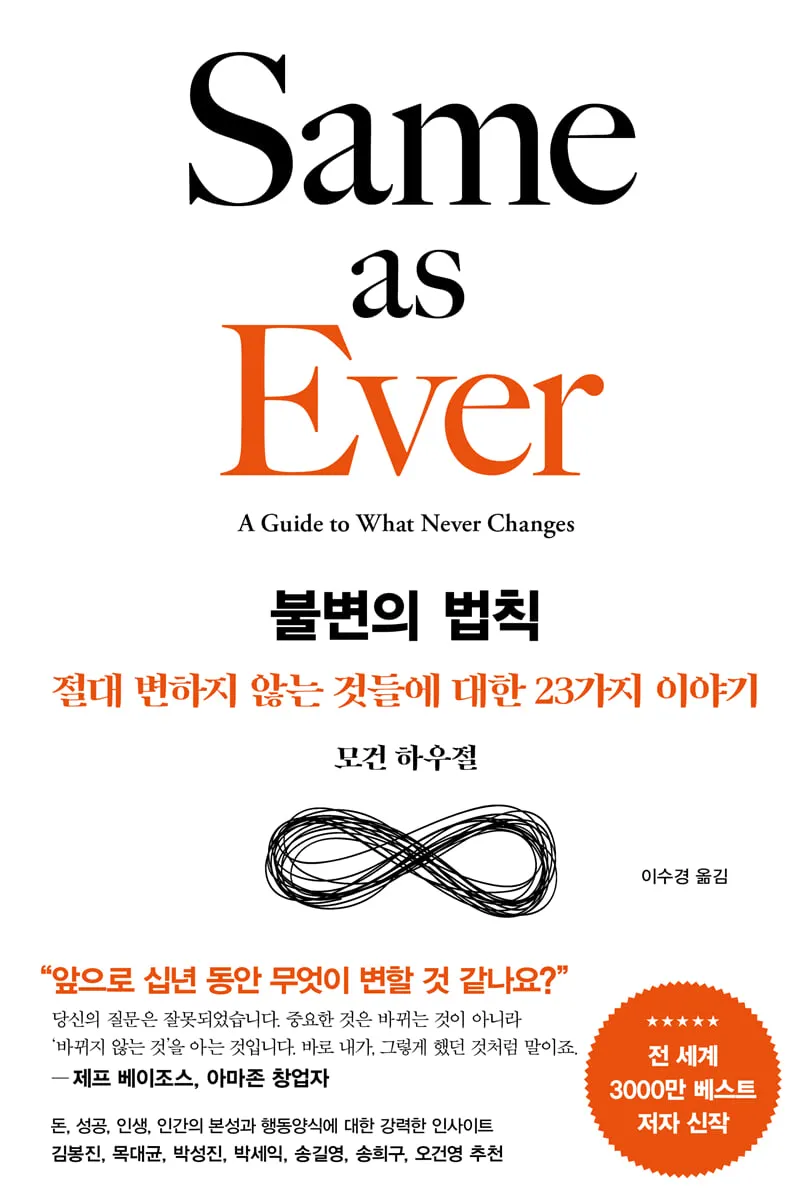
Same as Ever : Investing in What Never Changes
Same as Ever: Investing in What Never Changes - Elephant Index
Book Review & Insight
Same as Ever:
Investing in What Never Changes
Morgan Housel asks, “Instead of asking what will change in 10 years, ask what will not.” The single question that pierces through an uncertain future.
Elephant Index
|
Jan 11, 2026
|
18 min read
Idea in Brief
-
The Futility of Prediction: The future is the domain of fortune-tellers. In investment and business, what matters is not ‘predictive ability’ but the ‘Margin of Safety’ to survive when predictions fail.
-
The Happiness Equation: Even if wealth increases, if expectations rise faster, we feel poor. Happiness is strictly ‘Results minus Expectations’.
-
The Power of Storytelling: Markets are driven not by Excel data, but by stories that move people’s hearts.
-
The Price of Success (Fee): Volatility and pain are not fines for doing something wrong, but admission fees for obtaining superior returns.
We always ask, “What technology will change the world next year?” or “What industries will be promising in 10 years?” especially now in 2026, as AI and technological revolutions accelerate, the obsession with change is more intense than ever. However, Amazon founder Jeff Bezos once said: “I very frequently get the question: ‘What’s going to change in the next 10 years?’ I almost never get the question: ‘What’s not going to change in the next 10 years?’”
Morgan Housel, the author of the global bestseller The Psychology of Money, starts his book 『Same as Ever』 with this very question. He focuses on human nature and the ways of the world that repeat throughout history. Technologies change, but human greed, fear, and the instinct to seize opportunities do not.
1. Risk Comes From What You Don’t See
We mistake risk for something calculable. We run Excel models and build scenarios. But Housel defines risk as “what’s left over when you think you’ve thought of everything.” True risk comes from where no one predicted, at a timing no one imagined.
Case Study: Bill Gates & Kent Evans
Bill Gates & Kent Evans: The Two Sides of Luck and Risk
Bill Gates attended Lakeside School in Seattle, one of the few high schools in the world at the time to own a computer. This ‘one in a million luck’ made Gates who he is.
However, Gates had a best friend named Kent Evans. Evans was as brilliant as Gates and would have likely co-founded Microsoft, but he died in a mountaineering accident before graduation. The probability of dying in a mountaineering accident was also ‘one in a million.’
Insight: We praise the efforts of the successful but overlook the misfortune of those who fail. Gates and Evans had the same abilities, but the god of probability rolled different dice for them. Risk and luck are two sides of the same coin, and we must admit that there are realms we cannot control.
2. Expectations Determine Happiness
The 1950s in America are remembered as a golden economic era. Yet, actual data shows that per capita income, housing, and healthcare were far inferior to today. Today’s middle class enjoys better healthcare and entertainment than Rockefeller did in the 1950s. Why, then, do people miss those days and feel more unhappy now?
Moving the Goalpost
It is precisely because ‘expectations’ were lower. Back then, the gap between one’s life and their neighbor’s wasn’t vast. The tragedy of modern society is that while wealth increases, the expectations formed by comparing ourselves with others via social media increase even faster.
“Happiness is Results minus Expectations.
(Happiness = Results - Expectations)”
No matter how great the achievement, if expectations rise with it, satisfaction remains stagnant. Housel emphasizes that “managing expectations is the investment that guarantees the highest return.” If you don’t set your own standard for ‘Enough’, you will live in perpetual lack.
3. Stories Are More Powerful Than Statistics
The world doesn’t run logically like an Excel sheet. People respond to stories that touch their hearts rather than accurate data. This is why products with superior technology often lose to products with better marketing, and why stocks that make no rational sense skyrocket.
Case Study: The Great Depression
The Great Depression and the Power of Narrative
During the Great Depression in 1929, what was more terrifying than the drop in economic indicators was the story of ‘pessimism’. As the narrative that “the world is doomed” dominated people’s minds, consumption and investment actually stopped, and the economy collapsed.
Conversely, after WWII, the optimistic story that “peace and prosperity are coming” led to the Baby Boom and an explosion in consumption. Numbers cannot beat stories. If you are a leader or an investor, you must first read what story has captivated the people.
4. Pain is a Fee, Not a Fine
Volatility is the greatest enemy of stock investment. But Housel interprets it differently. To achieve successful long-term investment, one must endure immense psychological pain, which is a ‘Fee’, not a ‘Fine’.
Case Study: Netflix
Netflix’s 35,000% Return and the Price
From 2002 to 2018, Netflix’s stock rose 350-fold (35,000%). It is one of the greatest investments in history. But the journey was hellish. During that period, Netflix’s stock crashed by more than 50% on four separate occasions.
Insight: Most investors treated this volatility as a signal that something was wrong (a fine) and left the market. However, volatility is the legitimate admission fee one must pay to obtain superior returns. Just as “there must be rain for a rainbow to appear,” there is no magic of compounding without pain.
5. Stability Breeds Instability (The Paradox of Stability)
Ironically, the more peaceful the world becomes, the more complacent people get, and they start speculating with debt. “Stability itself creates instability.” This is a law not just of economics, but of nature.
Case Study: California Wildfires
The Paradox of California Wildfires
The US Forest Service once extinguished every small fire immediately to protect the forests. As a result, dry brush—which should have burned away naturally—accumulated massively. Ten years later, a stray spark ignited this brush, leading to uncontrollable ‘megafires’.
Insight: You must allow small crises (Small Forest Fires) to prevent large ones. If you artificially try to stop economic recessions or small corporate failures, you eventually pay the price of a total system collapse. Moderate stress boosts the system’s immunity.
6. Conclusion: Stand on the Foundation That Doesn’t Change
In 2026, the world is changing faster than ever. Paradoxically, that is why we must focus even more on what does not change. Amazon doesn’t worry about “How can we make delivery slower?” because customers will still want fast delivery and low prices 10 years from now.
Humans will still be seduced by stories, become arrogant with certainty about the future, and become unhappy by comparing themselves to others. Those who understand these immutable laws can find their center amidst chaos.
Morgan Housel advises us: “Invest in things that are Same as Ever.” That is the most certain preparation for the future.