📚 Two Books in Dialogue #13 · Is the world order breaking down, or are we entering a new cycle?
서평 지정학 경제전망
A shipment takes a longer route than it used to. The freight bill still comes in dollars. The route has changed, while the way the shipment is paid for has stayed the same. Which of those changes would tell us that the world order had shifted?
In Disunited Nations (2020), Peter Zeihan asks how geography, resources, and trade shape the options available to countries if the United States steps back from sustaining the world order. In Principles for Dealing with the Changing World Order (2021), Ray Dalio asks how major powers build and lose the institutions and financial credibility that underpin their influence. Zeihan starts with shipping routes and population maps. Dalio starts with national balance sheets and centuries of history.
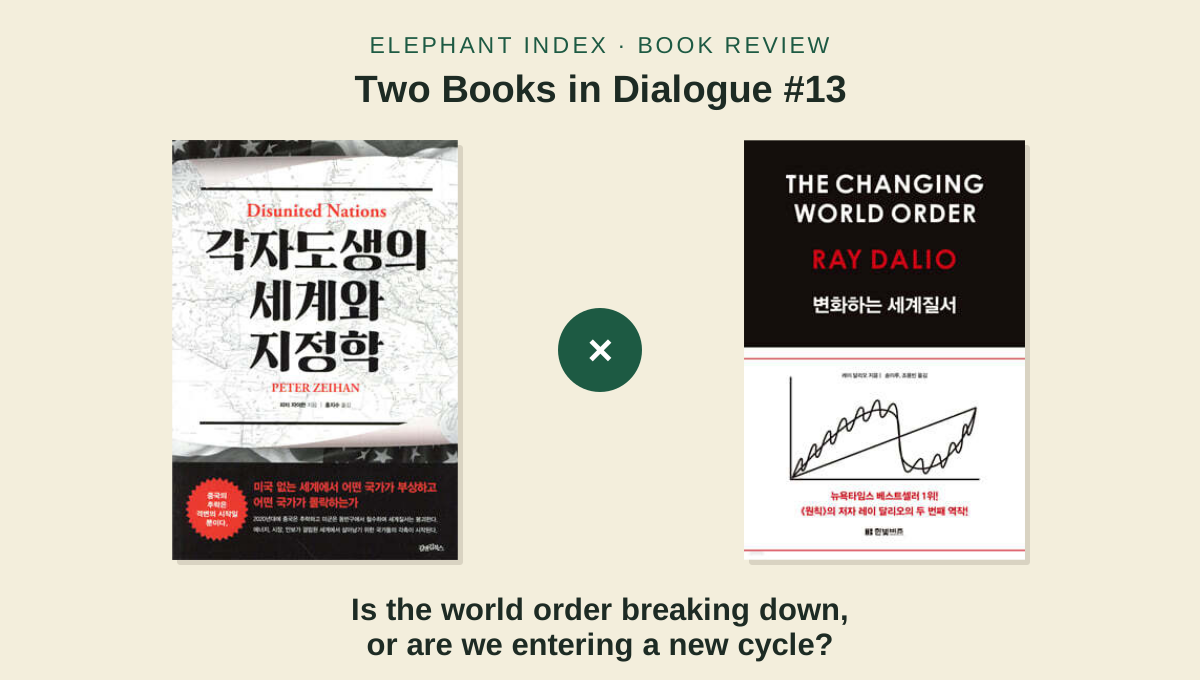
Disunited Nations Peter Zeihan |
Principles for Dealing with the Changing World Order Ray Dalio |
Korean edition covers · Kim & Kim Books · Hanbit Biz (YES24)
Zeihan traces postwar globalization to the maritime security and open trading system the United States helped sustain. Companies could split production among countries because they could count on ships reaching distant markets on schedule. Once that assumption weakens, the cost goes beyond freight rates. A longer route can force a company to carry more inventory and tie up working capital for longer. Zeihan sees those costs as a reason to move production closer to customers or suppliers.
Age structure shapes labor supply, consumption, saving, and pension spending. China’s National Bureau of Statistics reported a population of 1.405 billion at the end of 2025, down 3.39 million from a year earlier. People aged 60 or older accounted for 23.0%. The figures show the scale of population aging. Its effect on output depends on productivity, automation, labor force participation, and retirement policy. National Bureau of Statistics of China, 2025 statistical communiqué
Zeihan sees an advantage for North America, which can source much of its energy and food nearby, over manufacturing centers that rely on long import routes. In September 2026, the US Energy Information Administration reported that US crude oil production averaged 13.7 million barrels per day in the first half of 2026, up 2% from the same period in 2025. That capacity gives the United States room to respond to disruption. Domestic fuel prices still respond to global markets, and refineries need crude grades their equipment can handle. EIA, September 2026 crude oil analysis
Globalization depends on reliable shipping, access to energy, and populations that can sustain production and consumption. When those conditions change, regions and industries face different risks.
In Dalio’s long-term debt cycle, credit brings spending forward and finances investment. Strain builds when debt service rises faster than income. Borrowers cutting debt can depress demand, while efforts by governments and central banks to cushion the downturn can put pressure on prices or confidence in the currency. The same debt ratio can carry very different risks depending on maturity, interest costs, and whether borrowers can issue debt in their own currency.
For Dalio, international currency status grows out of strength in trade and finance and helps sustain that strength. When firms write contracts in dollars, hedge in dollar markets, and keep reserves in dollar assets, switching currencies requires coordination across all three activities. IMF data show that the dollar’s share of global foreign exchange reserves fell from 57.18% to 56.70% in the second quarter of 2026, while the value of dollar holdings was largely unchanged. The share can fall when holdings in other currencies rise. IMF COFER, second quarter of 2026
Dalio compares the Netherlands, Britain, and the United States to trace how education, productivity, trade, and financial markets can reinforce one another. Over time, debt and wealth gaps can widen, domestic conflict can grow, and a new rival can emerge. Fiscal and security demands then come at a time when political agreement may be harder to reach. Dalio’s “Big Cycle” describes how those pressures can build together. Dalio’s historical comparison charts
Economic strength and institutional trust can build an enduring position of power. Debt burdens, domestic conflict, and external rivalry can make that position more expensive to maintain.
| Issue | Zeihan’s first question | Dalio’s first question |
|---|---|---|
| United States | Can it secure energy and production close to home? | Can it sustain confidence in Treasuries and the dollar as deficits and interest costs rise? |
| China | How well can it adapt to aging, imported raw materials, and long shipping routes? | Can manufacturing strength support domestic demand and financial influence? Who bears property and local government losses? |
| Globalization | If supply is interrupted, what can be made elsewhere, and where? | Do settlement currencies and capital flows change when trade routes shift? |
| Transitions of power | Who can keep trade routes open and supply essential goods? | Whose currency and assets will other countries choose to hold? |
US energy capacity and fiscal capacity tell different stories. The IMF puts the US federal deficit at 5.9% of GDP in fiscal year 2025. High oil output gives the country options when supplies are disrupted, while deficits and interest costs still constrain the budget. Even as those costs rise, a reserve currency challenger needs deep financial markets of its own. IMF, 2026 United States Article IV consultation
China’s manufacturing strength can coexist with weak domestic demand. The IMF finds that the property adjustment strained local government finances and weakened domestic demand, while export growth partly offset that weakness. Zeihan’s framework highlights China’s exposure when trade routes or markets are disrupted. Dalio’s asks who absorbs the losses. The ability to produce more goods and the ability of households to buy more depend on different conditions. IMF, China Article IV consultation
Both authors focus on what happens when the costs of maintaining an order become visible. Unreliable shipping can push companies to hold more inventory, raising financing costs. Tighter credit can make it harder to invest in new plants or alternative supply routes. Zeihan’s supply constraints and Dalio’s credit constraints can show up on the same company’s balance sheet.
Zeihan’s framework locates bottlenecks and can understate how quickly businesses adapt. In October 2026, the WTO said US–China trade decoupling had accelerated since 2025. It also forecast that world merchandise trade volume would rise 3.9% in 2026. Demand tied to AI investment supported goods trade, while transport disruptions in the Middle East weighed on other activity. A forecast for one year leaves the long-term direction open. It also shows how bilateral trade can weaken while global trade grows. A company may import less directly from one country and still buy crucial parts from that country in goods assembled elsewhere. WTO, October 2026 Global Trade Outlook
Dalio’s cycle helps explain why pressures coincide and offers little precision on timing. When debt and internal conflict rise together in past great powers, the comparison alone cannot tell us which caused the decline or whether the next country will follow the same sequence. To judge a currency’s international role, track reserves alongside invoicing, foreign currency borrowing, and the assets investors buy in a crisis. Those measures can move in different directions for years.
For a South Korean business, the two books suggest practical questions about sourcing and funding. Does the backup supplier obtain critical parts from a different source? How many months of additional inventory can the company finance if shipping takes longer? If delivery times and dollar funding costs rise together, which constraint hits operations first?
The evidence points to a transition unfolding at different speeds. For some routes and products, the old promise of predictable delivery has already weakened. Trade is finding alternative routes, while finance still relies on established dollar markets. Moving a factory calls for a different set of decisions than getting companies, lenders, and central banks to use a new currency.
I would look for changes that persist after the immediate shock passes. If companies keep alternative suppliers after freight costs fall, that would point to a structural shift in trade. If the dollar’s reserve share falls over several years and other currencies gain ground in contracts and borrowing, the case for a shift in the financial order would grow stronger.
If factories and shipping routes have moved while contracts and savings are still denominated in dollars, when would you say the world order has changed?