📚 Two Books in Dialogue #05 · Should the future be designed, or discovered through experiments?
Today’s Two Books
Today we read Peter Thiel and Blake Masters’ Zero to One alongside Eric Ries’ The Lean Startup. Both books are about building something new under uncertainty, but they disagree on the sequence of questions that matters most. Zero to One asks what unique future is worth creating; The Lean Startup asks how to test whether our assumptions about that future are actually true.
Zero to One, published in 2014, distills Thiel’s thinking on startups, technology, competition, and monopoly. Its central concern is not how to copy what already works, but how to create something meaningfully new—moving from “0 to 1.” The Lean Startup, published in 2011, grew out of Ries’ experience in startups and software. It focuses on how to reduce waste when product, customer, and market assumptions are still uncertain.
Placed side by side, the books create a productive tension between conviction and evidence: Should founders begin with a bold view of the future and build toward it, or should they begin with hypotheses and let customer behavior shape the answer?
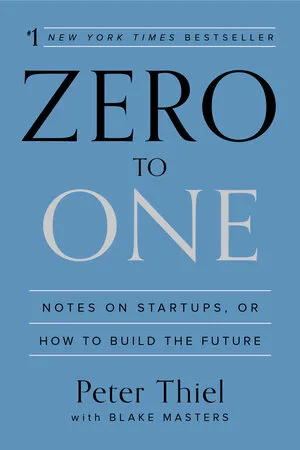
Zero to One
Peter Thiel with Blake Masters
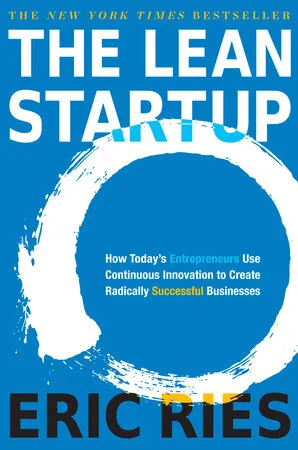
The Lean Startup
Eric Ries
🎙️ First Voice — Zero to One
Thiel’s most provocative argument is that the most valuable companies do not simply compete better inside an existing market. They create something so different that they temporarily escape direct competition. The entrepreneur’s task is therefore not merely to optimize what already exists, but to discover and build a future that is not yet obvious.
- From 0 to 1
Going from 1 to n means replication: taking a known model and scaling it. Going from 0 to 1 means invention: creating a genuinely new product, technology, business model, or category. Thiel believes the latter is where the greatest long-term value is created because it changes what is possible rather than simply expanding what already exists.
- Differentiation over competition
Thiel is skeptical of markets defined by intense competition. If many companies offer nearly identical products, profits are competed away and strategic freedom disappears. A stronger position comes from proprietary technology, network effects, economies of scale, brand, or some other advantage that makes direct imitation difficult.
- Start small, then dominate
Instead of targeting an enormous market immediately, Thiel recommends starting with a small, clearly defined market that a startup can realistically dominate. Once the company becomes strong in that niche, it can expand outward into adjacent markets. The logic is concentration before expansion.
- Secrets and long-term conviction
Thiel argues that valuable opportunities often begin with a “secret”—an important truth about the world that few people currently believe or understand. Founders therefore need a point of view that differs from consensus. Building a company is not simply reacting to customer requests; it also requires a coherent belief about a future that does not yet exist.
“What valuable company is nobody building?”
This question captures the book’s challenge: find an important future that others are not yet creating.
🎙️ Second Voice — The Lean Startup
Ries begins from a different problem. Startups can execute beautifully and still fail because they build something customers do not want. The biggest risk is not necessarily poor execution; it is spending too much time and money executing the wrong idea. The remedy is disciplined experimentation.
- Build–Measure–Learn
The core loop of the Lean Startup is simple: build the smallest useful experiment, measure how real customers respond, and learn whether the underlying assumptions are valid. The goal is not activity for its own sake. It is to shorten the time between an idea and reliable learning.
- Minimum Viable Product
An MVP is not simply a low-quality version of the final product. It is the smallest version of an idea that can generate meaningful evidence about a critical assumption. The right MVP depends on what the team most needs to learn, not on how much product it can build.
- Validated learning
Ries argues that startups need a form of progress different from traditional execution metrics. Revenue, feature count, and growth can be misleading if they do not prove that customers value the product in a sustainable way. Validated learning means turning customer behavior into evidence that supports—or contradicts—the business model.
- Pivot or persevere
Experiments matter because they create decision points. If evidence repeatedly contradicts a core assumption, the team may need to pivot: change the product, customer, channel, revenue model, or another fundamental element. If the evidence is strong, the team can persevere and scale with greater confidence.
“The only way to win is to learn faster than anyone else.”
The strategic advantage of a startup is not perfect prediction, but faster, higher-quality learning.
⚖️ Where the Two Books Directly Clash
Zero to One begins with vision. Founders should hold a differentiated view of the future and build something that customers may not yet know how to request. The Lean Startup begins with uncertainty. Founders should treat assumptions as hypotheses and expose them to evidence as early as possible.
Taken too far, Thiel’s approach can become stubbornness: a founder may mistake personal conviction for insight and ignore contradictory evidence. Taken too far, Ries’ approach can become incrementalism: a company may optimize endlessly around what customers say today and never build the breakthrough product they could not have imagined in advance.
🤝 Where the Two Books Unexpectedly Meet
Despite the apparent disagreement, both books reject passive entrepreneurship. Neither says, “Write a business plan and execute it unchanged.” Thiel demands a real theory of differentiation; Ries demands real evidence. Both reject vague ambition. One forces the founder to answer, “Why must this company exist?” while the other asks, “What would prove that our belief is wrong?”
The strongest synthesis is therefore not vision versus experimentation, but vision plus experimentation. Vision tells the company where it wants to go. Experiments test whether the path, assumptions, and timing are correct. A company without vision may learn quickly but move nowhere important; a company without experimentation may move boldly in the wrong direction.
🌍 What This Looks Like in Practice
A practical way to combine the two books is to separate what should be strongly held from what should remain flexible. The mission, the problem worth solving, and the differentiated value proposition may deserve strong conviction. Customer segment, pricing, product packaging, onboarding flow, distribution channel, and feature priority should often remain testable.
For a technology company, this can mean committing to a long-term technical direction while running small commercial experiments around how customers buy and deploy the product. The destination can be ambitious, but the route should be allowed to change when evidence improves our understanding.
The same logic applies inside larger organizations. Leaders should not ask teams to “experiment” without boundaries, nor should they lock every detail into a fixed plan. A useful operating model is: define the strategic thesis clearly, identify the assumptions that could invalidate it, and design fast tests for those assumptions before committing large resources.
💭 My Take
The most useful lesson from reading these two books together is that conviction and humility are not opposites. A founder can have a strong belief about the future while remaining humble about the exact path to reach it. In fact, the stronger the ambition, the more important it becomes to test the assumptions underneath it.
Many organizations confuse changing tactics with changing direction. They become emotionally attached to a plan because they fear that revising the plan signals weakness. But a strong strategy can survive many tactical changes. What should remain stable is the reason the company deserves to exist; what should remain flexible is the mechanism for proving and delivering that value.
The future is not fully designed and it is not fully discovered. We choose a direction worth pursuing, then use reality to refine the route.
✍️ One Sentence to Keep
“Hold the vision firmly, but hold the path loosely.”
❓ What Do You Think?
When building something new, which is more dangerous: lacking conviction, or becoming too attached to your original idea? And in your current work, which assumptions should be defended as part of the strategy—and which ones should be tested immediately?